
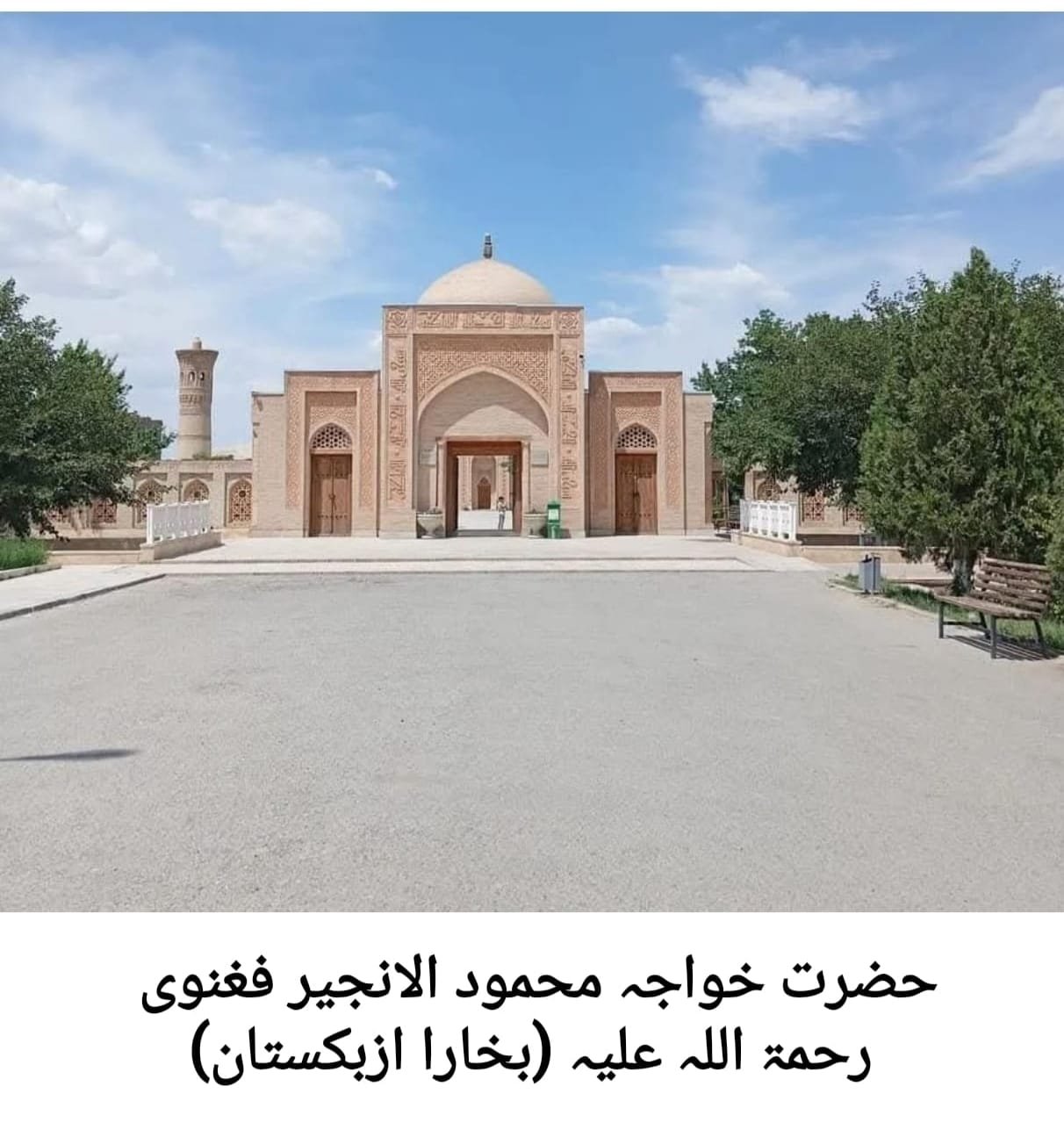
Hazrat Khwaja Mahmood al-Faghnavi (رحمۃ اللہ علیہ)
He was a preeminent leader of the spiritual path (Tariqah) and a source of profound gnosis (Ma’rifat), from whose purified heart flowed springs of sacred knowledge and divine wisdom. His heart was so polished by the luminous manifestations of Allah Almighty that he became one of the chosen and elect servants of the Divine, purified from all inner darkness and impurities, as clear and transparent as a mirror.
Birth and Early Life
He was born in the village of Anjir Faghna, located approximately three miles from Bukhara Sharif. During his youth, he earned his livelihood through masonry. He dedicated his entire life to inviting the creation of Allah toward His Divine Presence and guiding them along the path of spiritual upbringing and righteousness.
He is the first exalted Sheikh of the Silsila-e-Khwajagan (the predecessors of the Naqshbandiyya order) who, considering the requirements of his time and the spiritual states of the seekers, initiated the practice of Dhikr-e-Jahr (remembrance of Allah in a loud voice). When asked why he practiced loud invocation, he replied: “In order to awaken the sleeping (heedless) hearts.”
The Conditions and Acceptance of Dhikr-e-Jahr
Once, while Hazrat Khwaja Mahmood al-Faghnavi (رحمۃ اللہ علیہ) was present in a scholarly assembly, the great saint Sheikh Shamsuddin Halwai (رحمۃ اللہ علیہ) asked the renowned jurist and scholar, Sheikh Hafizuddin (رحمۃ اللہ علیہ), to inquire from Hazrat Khwaja Mahmood (رحمۃ اللہ علیہ) why he practiced Dhikr-e-Jahr.
Hazrat Khwaja Mahmood al-Faghnavi (رحمۃ اللہ علیہ) gave a profound response, stating:
”This (Dhikr-e-Jahr) is the most excellent means to awaken the heedless human from the slumber of negligence and to divert the attention of the indifferent toward Allah, so that they may follow the Sheikh in remembrance and embark upon the straight path, ultimately attaining Tawbah-e-Nasuh (sincere repentance), which is the key to all virtues and blessings. If your intention is pure and sincere, you will be granted the permission and the impact of Dhikr-e-Jahr yourself.”
Upon this, Sheikh Hafizuddin (رحمۃ اللہ علیہ) requested further clarification regarding who is truly qualified to practice Dhikr-e-Jahr according to the principles of Sharia and Tariqah, so that an argument could be presented to those who object to this practice.
He replied:
”The practice of Dhikr-e-Jahr is permissible and appropriate only for the one who possesses a firm resolve to purify their tongue from lies and backbiting, protect their inner self from forbidden and unlawful acts, and cleanse their heart from pride, ostentation, and the desire for fame.”
Miracles
Some of his well-known miracles (Karamaat) are as follows:
Once, while he was engaged in the remembrance of Allah with his disciples in the desert, reciting “Allah, Allah” in a loud voice, a flock of birds passed overhead. The disciples observed that as soon as the birds reached above the gathering of Khwaja Mahmood (رحمۃ اللہ علیہ), they suspended in mid-air and stopped flapping their wings. After a while, one of the birds descended, sat on his shoulder, and began to chirp in its own language. Khwaja Mahmood (رحمۃ اللہ علیہ) looked at his disciples and said: “This bird is saying that we too have been intoxicated by the sweetness of this divine remembrance and are engaged in the praise and glorification of Allah.”
A major miracle of his was that when he performed Dhikr-e-Jahr, the impact of his spiritual influence and divine state would affect the surrounding environment. Many reliable books state that when a state of spiritual ecstasy (Wajd) would overtake him, the walls of the Khanqah, the trees, and even the dry wood would join him in the remembrance of Allah, and the sound of “Allah” could be heard from them.
The Testimony of Hazrat Khizr (عليه السلام)
One day, the great Sheikh of the Silsila, Hazrat Khwaja Ali Ramitani (رحمۃ اللہ علیہ), narrated that a person met Hazrat Khizr (عليه السلام) and requested: “Guide me to a perfect human being who strictly follows the Sharia of the Holy Prophet (ﷺ) and the Straight Path, so that I may follow and emulate him.” Hazrat Khwaja Khizr (عليه السلام) replied: “The perfect soul you are searching for is Sheikh Mahmood al-Anjir al-Faghnavi (رحمۃ اللہ علیہ).”
Spiritual Resonance and Perfection
Biographers state that Hazrat Khwaja Mahmood (رحمۃ اللہ علیہ) walked in the footsteps of the Prophet of Allah, Muhammad Mustafa (ﷺ), in his state of Divine Gnosis, and in the attribute of Kalam-e-Ilahi (the station of Kalimullah), he possessed a special spiritual affinity with Hazrat Musa (عليه السلام).
Demise
He constructed a mosque in the village of Wabkani near Bukhara, where he radiated the light of knowledge and spiritual gnosis for many years. Finally, he departed from this transient world on the 17th of Rabi al-Awwal, 717 AH, in a town near Bukhara called “Qulat.” Before his passing, he entrusted the spiritual secret of the Silsila-e-Aliya Naqshbandiyya and the great amanah of his Caliphate to his exalted disciple and successor, Hazrat Khwaja Ali Ramitani (رحمۃ اللہ علیہ).