
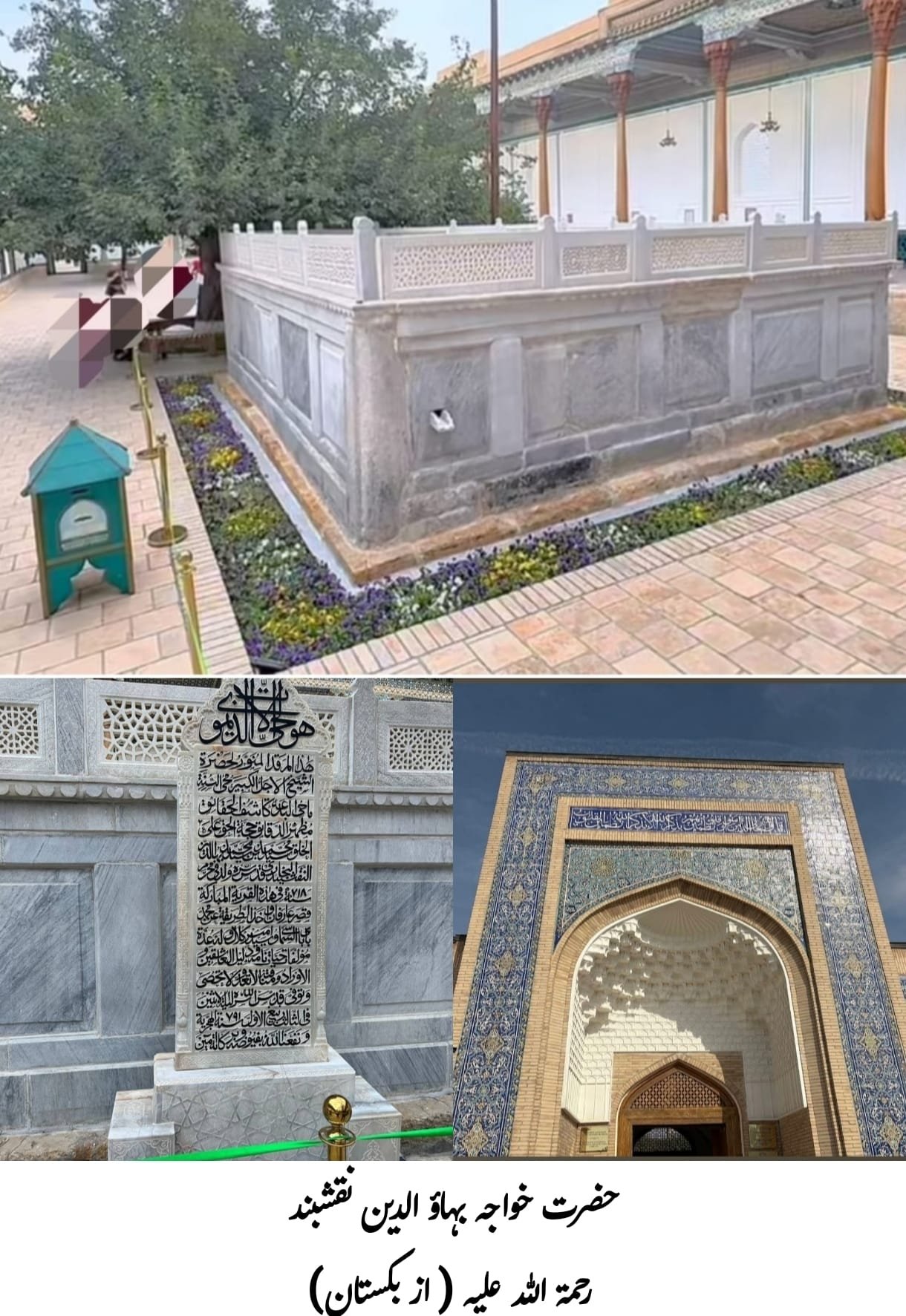
Hazrat Muhammad Bahauddin Shah Naqshband (Rahmatullah Alaih)
He is an ocean of knowledge that has no shore. The waves of this ocean were woven with the pearls of Ilm-e-Ladunni (divinely inspired knowledge). Hazrat Shah Naqshband (Rahmatullah Alaih) purified humanity with the ocean of his innocence and piety. He quenched the thirst of souls with the pure water of his spiritual aid and victory. The entire world, including its oceans and continents, was within his grasp. He is the star adorned with the crown of guidance. He purified all human souls indiscriminately with his sacred breath. He illuminated the distant corners of the world with the secrets of Muhammad, the Messenger of Allah (Sallallahu Alaihi Wa Aalihi Wasallam). His magnificent arguments removed even the slightest whispers of doubt from the hearts of humanity. His powerful miracles gave life to dead hearts and provided provisions for souls for the realm of spirits.
He received training for the station of the Greatest Intercession (Shafa’at-e-Uzma) right from the cradle. He drank the nectar of the knowledge of the unseen (Ilm-e-Ghaib) from the cup of reality. All praise is due to Allah, Who sent such a reviver of faith (Mujaddid-e-Deen). He elevated the hearts of humanity and taught them to fly in the skies of spirituality. He made kings stand at his doorstep. He spread guidance from north to south and from east to west. He left no one deprived of heavenly assistance, even the wild beasts of the jungles. He is the greatest Ghaus (helper), Shafi (intercessor), Sultan-ul-Awliya (King of Saints) (Rahmatullah Alaih), and the necklace of all those spiritual pearls that were bestowed upon this world from the Divine Presence. Through the light of his guidance, Allah Almighty made the good even better and transformed evil into goodness.
He is the Imam of this Tariqah (spiritual path), the Sheikh of the Silsilah-e-Zahab (the Golden Chain), and the most excellent among those who carried this order forward from the Khwajagan (the Masters).
His blessed birth took place in the month of Muharram 717 AH (1317 CE) in the village of Qasr-e-Arifan, located near Bukhara. Allah Almighty bestowed miracles upon him since childhood. He was taught the secrets of this spiritual path by his first master, Sayyid Muhammad Baba Samasi (Rahmatullah Alaih). Then, the secret and perfection of this path were bestowed upon him by his Sheikh, Sayyid Amir Kulal (Rahmatullah Alaih). He also had an Uwaisi (spiritual) connection with the Holy Prophet Muhammad (Sallallahu Alaihi Wa Aalihi Wasallam), as his spiritual upbringing took place in the spiritual presence of Hazrat Abdul Khaliq Ghajdawani (Rahmatullah Alaih), who had veiled himself from this world 200 years prior to his time.
The Beginning of His Guidance and the Guidance of the Beginning
Hazrat Shah Naqshband (Rahmatullah Alaih) was eighteen years old when his grandfather sent him to the village of Samas to serve the Sheikh of the spiritual path, Muhammad Baba Samasi (Rahmatullah Alaih), who had summoned him. From the very beginning of the Sheikh’s company, he felt countless blessings within himself and a tremendous longing of sincerity and devotion. Regarding his youth, he states:
”I would wake up early in the morning, three hours before the Fajr prayer, perform ablution, and after offering the Sunnah prayers, I would fall into prostration and supplicate to Allah Almighty: ‘O my Lord! Grant me the strength to bear the hardships and pain of Your love.’ Then I would perform the Fajr prayer with the Sheikh. One day, while going out, he looked at me and said, as if he were with me when I was supplicating, ‘O my son! You must change the manner of your prayer. Instead, say, “O Allah! Grant Your pleasure to this weak servant.” Allah does not like His servants to be in hardship. Although Allah, in His wisdom, may give some hardships to test His servants, the servant himself should not seek difficulties. This would be a lack of manners in the presence of your Lord.'”
”When Sheikh Muhammad Baba Samasi (Rahmatullah Alaih) passed away, my grandfather took me to Bukhara and married me there. I began living in Qasr-e-Arifan, which was a special favor of Allah upon me because I was close to Sayyid Amir Kulal (Rahmatullah Alaih). I remained in his service, and he told me that Sheikh Muhammad Baba Samasi (Rahmatullah Alaih) had told him a long time ago, ‘If you do not take care of him, I will be displeased with you.’ One day, I was sitting in seclusion with a friend when the heavens opened, a great vision (Kashf) descended upon me, and I heard a voice saying, ‘Is it not enough for you that you leave everyone and come solely to Our presence?’ This voice sent a tremor through me, and I fled from that house. I ran to a river where I threw myself down. I washed my clothes and offered two units of prayer in a manner I had never prayed before; I felt as if I was praying directly in the Divine Presence. In the state of Kashf, everything was revealed to my heart. The entire universe disappeared, and I lost all consciousness of anything except praying in His presence.”
”At the beginning of my state of spiritual attraction (Jazb), I was asked, ‘Why do you wish to walk this path?’ I replied, ‘So that whatever I say and whatever I wish, happens.’ I received the reply, ‘It will not be so. Whatever We say and whatever We wish, will happen.’ I submitted, ‘I cannot do that. I must be allowed to say and do what I wish, otherwise I do not want this path.’ Then I received the reply, ‘No, what We wish will be said, and what We wish will be done.’ And I said again, ‘What I say and what I do must happen.’ Then I was left alone for fifteen days, until I fell into a state of severe sadness. Then I heard a voice, ‘O Bahauddin, whatever you wish, We shall grant.’ I was filled with boundless joy. I submitted, ‘I desire a path (Tariqah) that takes everyone who walks upon it straight to the Divine Presence.’ And a great Kashf descended upon me, and I heard a voice saying, ‘What you have asked for has been granted to you.'”
His Stages and Spiritual Struggles (Mujahadat) in the Tariqah
He states:
”Once, in a state of spiritual attraction (Jazb) and self-forgetfulness, I was wandering here and there, unaware of what I was doing. When darkness fell, my feet were bleeding, pierced by thorns. I felt myself drawn toward the house of my Sheikh, Sayyid Amir Kulal (Rahmatullah Alaih). It was a pitch-black night with neither moon nor stars. The wind was freezing, and I had nothing but an old leather cloak. When I reached his house, he was sitting with his friends. When he saw me, he said to his disciples, ‘Throw him out, I do not want him in my house.’ They threw me out, and I felt my lower self (Nafs) trying to overcome me, attempting to take control of my heart and emotions to poison my faith in my Sheikh (Rahmatullah Alaih). At this point, Allah’s help and His mercy were my only refuge to bear this humiliation in the path of Allah and my Sheikh (Rahmatullah Alaih). I said to my Nafs, ‘I will never allow you to poison my faith in my Sheikh (Rahmatullah Alaih).’ I was so exhausted and sorrowful that I placed the head of humility at the doorstep of pride—meaning, I placed my head upon the threshold of my master’s door and swore that I would not lift my head until he accepted me again. Snow began to fall, and the cold wind pierced through to my bones, causing me to shiver in that dark night. There was not even the warmth of the moon to console me. I lay in this state until I froze. But the love that was in my heart—the love of Allah and the love of the door of Allah, which is my Sheikh (Rahmatullah Alaih)—kept me warm.”
”Morning came, and my Sheikh (Rahmatullah Alaih) stepped out of his door without seeing me physically. He placed his foot upon my head, which was still on his threshold. Upon feeling my head, he immediately withdrew his foot, took me inside his house, and said to me, ‘O my son! You have been clothed in the garment of ultimate bliss. You have been clothed in the garment of Divine love. You have been clothed in a garment that neither I nor my Sheikh (Rahmatullah Alaih) was ever clothed in. Allah is pleased with you. The Holy Prophet (Sallallahu Alaihi Wa Aalihi Wasallam) is pleased with you. All the Shuyukh of the Golden Chain (Rahmatullah Alaih) are pleased with you…’ Then, with great love and care, he removed the thorns from my feet and washed my wounds. Along with this, he poured into my heart that knowledge which I had never experienced before. Through this, a Kashf opened upon me in which I saw myself entering the secret of Muhammad, the Messenger of Allah (Sallallahu Alaihi Wa Aalihi Wasallam). I saw myself entering the secret of the verse which is the Muhammadan Reality (Haqiqat-e-Muhammadiyyah) (Sallallahu Alaihi Wa Aalihi Wasallam). It entered me into the secret of La ilaha illa Allah, which is the secret of Oneness (Wahdaniyyat). Then it entered me into the secrets of the Names and Attributes of Allah, which manifest from the secret of Singularity (Ahadiyyat). These states cannot be expressed in words; rather, they can only be known through the spiritual taste (Zauq) felt within the heart.”
”At the beginning of my spiritual journey, I used to travel from one place to another in the outskirts of Bukhara at night. In the darkness of the night, especially in winter, I would visit graveyards to take heed from the dead. One night, I was guided to go to the grave of Sheikh Ahmad Ajgharawi (Rahmatullah Alaih) and recite Al-Fatiha for him. When I arrived, I found two men, whom I had never met before, waiting for me with a horse. They seated me on the horse and tied two swords to my back. They turned the horse toward the grave of Sheikh Mazdakhin (Rahmatullah Alaih). When we arrived, we all dismounted our horses and entered the shrine and mosque of the Sheikh (Rahmatullah Alaih). I sat facing the Qiblah, engaged in meditation (Muraqabah), and connected my heart with the heart of that Sheikh (Rahmatullah Alaih).”
”During this meditation, a Kashf opened upon me, and I saw that the wall facing the Qiblah collapsed. A magnificent throne appeared. A person of immense stature, who cannot be described in words, was seated upon that throne. I felt that I knew him. Wherever I turned my face in this universe, I saw that same person. Around him was a large crowd, which included my Shuyukh, Sheikh Muhammad Baba Samasi (Rahmatullah Alaih) and Sayyid Amir Kulal (Rahmatullah Alaih). Then, I felt fear toward this great person, while at the same time, I felt love for him. I had fear of his Majesty (Jalal) and love for his Beauty (Jamal) and attraction. I said to myself, ‘Who is that great person?’ I heard a voice from among the crowd saying, ‘This great person who nurtured you on your spiritual path is your Sheikh (Rahmatullah Alaih). He has been watching your soul since the time it was merely a particle in the Divine Presence. You have been under his upbringing. He is Sheikh Abdul Khaliq Ghajdawani (Rahmatullah Alaih), and the crowd you see are his vicegerents (Khulafa) (Rahmatullah Alaih) who carry his great secret, the secret of the Golden Chain.’ Then the Sheikh (Rahmatullah Alaih) pointed toward each Sheikh and said, ‘This is Sheikh Ahmad (Rahmatullah Alaih); this is Kabir al-Awliya (Rahmatullah Alaih); this is Arif Riwagari (Rahmatullah Alaih); this is Sheikh Ali Ramitani (Rahmatullah Alaih); this is your Sheikh, Muhammad Baba Samasi (Rahmatullah Alaih), who gave you his cloak (Khirqah) during his lifetime. Do you know them?’ I said, ‘Yes.'”
”Then he said to me, ‘That cloak which he gave you a long time ago is still in your house, and through its blessing, Allah has averted many calamities from your life.’ Then another voice came and said, ‘The Sheikh sitting on the throne (Rahmatullah Alaih) is going to teach you what you need while walking on this path.’ I asked if they would permit me to shake hands with him. They permitted me, the veil was removed, and I took his hand. Then he began to instruct me about the spiritual journey (Suluk), its beginning, its middle, and its end. He said, ‘You must correct the direction of your lower self (Nafs) so that the light of the unseen may grow strong within you and its secrets can be witnessed. You must show steadfastness and remain firm upon the Shariah of the Prophet (Sallallahu Alaihi Wa Aalihi Wasallam) in all your states. You must “enjoin what is good and forbid what is evil” and stand upon the highest standard of Shariah, abandoning dispensations (Rukhsat) and forsaking every kind of innovation (Bid’ah), and make the Ahadith of the Prophet (Sallallahu Alaihi Wa Aalihi Wasallam) your Qiblah. You must study his biography (Seerah) and the biography of his Companions (Radi Allahu Anhum), and encourage people to follow them and recite the Quran day and night, and perform prayers with all the supererogatory (Nawafil) acts. Do not neglect even the smallest of these actions and good deeds that the Prophet (Sallallahu Alaihi Wa Aalihi Wasallam) has taught us.'”
”As soon as Abdul Khaliq (Rahmatullah Alaih) finished speaking, his vicegerent (Rahmatullah Alaih) said to me, ‘To assure you of the truth of this vision (Kashf), he is sending you a sign. Tomorrow, go and meet Mawlana Shamsuddin Ambikoti (Rahmatullah Alaih), who will be judging between two people. Tell him that the Turk is truthful and the Saqqa (water-carrier) is a liar. Tell him, “You are trying to help the Saqqa, but you are mistaken. Correct yourself and help the Turk.” If the Saqqa denies your words, and the judge continues to help the Saqqa, tell them, “I have two proofs. The first is that you say to the Saqqa, ‘O Saqqa, you are thirsty.’ He will know what this thirst means. As for the second proof, you must say to the Saqqa, ‘You committed adultery with a woman and she became pregnant, and you aborted her child, and you buried that child under the grapevines.'” On your way to Mawlana Shamsuddin (Rahmatullah Alaih), take three dry raisins with you and pass by your Sheikh, Sayyid Amir Kulal (Rahmatullah Alaih). On your way to him, you will meet a Sheikh who will give you a loaf of bread. Take the bread and do not speak to him. Keep walking until you find a caravan. A wrestler will come to you. Advise and reprimand him. He will repent and join your followers. Wear your Qalansuwa (cap) and take the cloak of Azizan (Rahmatullah Alaih) to Sayyid Amir Kulal (Rahmatullah Alaih).'”
”After that, they moved me, and the Kashf ended. I returned to consciousness. The next day, I went to my house and asked my family about the cloak mentioned in the vision. They brought it to me and told me, ‘It had been lying there for a long time.’ When I saw the cloak, a state of intense inner weeping overcame me. I took the cloak and went to the mosque of Mawlana Shamsuddin (Rahmatullah Alaih) in the village of Ambikata on the outskirts of Bukhara. I prayed Fajr with them and then informed him about the sign, which astonished him. The Saqqa was present there and denied that the Turk was truthful. Then I informed them of the proofs. He admitted the first one and denied the second. Then I asked the people of the mosque to go toward the grapevines near the mosque. They did so and found the child who was buried there. The Saqqa came weeping and begged for forgiveness for what he had done, but the matter was now over. Mawlana Shamsuddin (Rahmatullah Alaih) and the others present in the mosque were in utter amazement.”
”The next day, I prepared to travel to the city of Nasaf (Qarshi), and I had those three dry raisins with me. Mawlana Shamsuddin (Rahmatullah Alaih) tried to stop me, saying, ‘I see in you the pain of longing for us and an intense desire to reach the Divine Presence. Your healing is in our hands.’ I replied to him, ‘O my Sheikh, I am the son of someone else and I am his follower. Even if you offer to benefit me from the highest station, I cannot accept it, except from the one to whom I have given my life and with whom I have taken the pledge of allegiance (Bay’ah).’ Then he became silent and permitted me to travel.”
”I continued walking according to the guidance until I met that Sheikh (Rahmatullah Alaih), and he gave me a loaf of bread. I did not speak to him. I took the bread from him, just as I had been commanded. Then I found a caravan. They asked me where I was coming from. I said, ‘Ambikata.’ They asked when I had left. I said, ‘At sunrise.’ They were astonished and said, ‘That village is miles away, and it should have taken you a long time to cover this distance. We left that village last night, and you left at sunrise, yet you have reached us.’ I kept walking until I met a horseman. He asked me, ‘Who are you? I feel afraid of you!’ I said to him, ‘I am the one at whose hands your repentance will take place.’ He dismounted his horse, showed complete humility before me, repented, and threw away all the wine he was carrying. He went with me to my Sheikh, Sayyid Amir Kulal (Rahmatullah Alaih). When I saw him, I gave him the cloak.”
”He remained silent for a while and then said, ‘This is the cloak of Azizan (Rahmatullah Alaih). I was informed last night that you were bringing it to me, and I have been commanded to keep it in ten different covers.’ Then he commanded me to enter his private room. He instructed me and inculcated the silent remembrance (Zikr-e-Khafi) into my heart. He commanded me to adhere to this *Zikr day and night. Since I had been commanded in the vision of Sheikh Abdul Khaliq Ghajdawani (Rahmatullah Alaih) to walk the strict and difficult path, I continued that silent remembrance, which is the highest form of Zikr. In addition, I used to attend the gatherings of the scholars of outward knowledge to acquire the knowledge of Shariah and the Ahadith of the Prophet (Sallallahu Alaihi Wa Aalihi Wasallam), and to learn about the character of the Prophet (Sallallahu Alaihi Wa Aalihi Wasallam) and his Companions (Radi Allahu Anhum). I did exactly as the vision had told me, and as a result, a major transformation occurred in my life. Whatever Sheikh Abdul Khaliq Ghajdawani (Rahmatullah Alaih) had taught me in that vision bore blessed fruits in my life. His soul was always with me, teaching me.”
Regarding Loud Remembrance (Zikr-e-Jali) and Silent Remembrance (Zikr-e-Khafi)
It is mentioned in the book Al-Bahjat-us-Saniyyah that from the era of Hazrat Mahmud Faghnawi (Rahmatullah Alaih) until the era of Sayyid Amir Kulal (Rahmatullah Alaih), the method of loud remembrance (Zikr-e-Jali) in gatherings and silent remembrance (Zikr-e-Khafi) in solitude was prevalent. However, when Shah Bahauddin Naqshband (Rahmatullah Alaih) received his secret, he adopted only Zikr-e-Khafi. Even in the gatherings of Sayyid Amir Kulal (Rahmatullah Alaih), when he would begin Zikr-e-Jali, Shah Naqshband would stand up, go to his room, and perform Zikr-e-Khafi. The disciples were somewhat upset by this: although their Sheikh (Rahmatullah Alaih) was performing loud Zikr, he was doing silent Zikr. Despite this, he spent his entire life in the service of his Sheikh (Rahmatullah Alaih).
One day, while Shah Bahauddin (Rahmatullah Alaih) and all the followers of Sayyid Amir Kulal (Rahmatullah Alaih) were resting from constructing a new mosque, Sayyid Amir Kulal (Rahmatullah Alaih) said: “Whoever harbored ill thoughts about my son Bahauddin (Rahmatullah Alaih) was wrong. Allah has given him a secret that no one before him has received. Even I was unable to know it.” And he said to him: “O my son! I have fulfilled the bequest and advice of Sheikh Muhammad Baba Samasi (Rahmatullah Alaih) when he commanded me to raise and train you in such a way that you would surpass me. I have done this, and now you have the capacity to traverse higher and higher stations. Therefore, my dear son, I now give you complete permission to go wherever you wish and acquire knowledge from whomever you want.”
Later Shuyukh (Spiritual Masters)
He said:
”Once, I accompanied Mawlana Arif Ad-Dic Karani (Rahmatullah Alaih) for seven years. Then, for several years, I accompanied Mawlana Qatham Sheikh (Rahmatullah Alaih). One night, I was sleeping in the presence of my Sheikh and I saw Sheikh Al-Hakim Attar (Rahmatullah Alaih), who was one of the famous Turkish Shuyukh, saying something to a dervish named Khalil Gharani (Rahmatullah Alaih). When I awoke, the image of that dervish became imprinted on my mind. I had a pious grandmother to whom I mentioned this dream. She told me, ‘O my son, you too will accompany many Turkish Shuyukh.’ Thus, I searched for Turkish Shuyukh during my travels, and I never forgot the image of that one dervish. Then one day, in my own country of Bukhara, I saw a dervish and recognized him as the person from my dream. I asked his name, and he told me, ‘I am Khalil Gharani.’ I had to leave him, but doing so made me feel very bad. At sunset, someone knocked on my door. I answered, and a stranger told me, ‘The dervish Khalil Gharani is waiting for you.’ I was very surprised. How did this person find me? I took a gift and went with him. When I reached his presence, I began to relate the dream to him. He said, ‘There is no need to tell me that dream; I already know it.’ This statement attached my heart to him even further. In his company, new sciences of the unseen opened upon my heart. He always looked after me, praised me, and elevated my spiritual ranks. The people of Mawar-un-Nahr made him their king. I continued his company even during his reign, and my love for him increased in my heart, and his heart elevated me further in knowledge. He taught me how one should remain in the service of a Sheikh. I remained in his company for six years. In his presence and in my solitude, I maintained my connection with him.”
”At the beginning of my journey on this path, I met a lover of Allah, and he said to me, ‘It seems as though you are one of us.’ I said to him, ‘I hope that you are one of us, and I hope to be your friend.’ Once he asked me, ‘How do you treat your lower self (Nafs)?’ I said to him, ‘If I receive something, I thank Allah, and if not, I am patient.’ He smiled and said, ‘That is easy. The path for you is to place a burden on your Nafs and test it. If it is deprived of food for a week, you should be able to restrain it from your disobedience.’ I was very pleased with his reply and sought his help. He commanded me to help the needy, serve the weak, and comfort broken hearts. He commanded me to adopt humility, meekness, and tolerance. I followed his commands and spent many days of my life in this manner. Then he commanded me to care for animals, treat their illnesses, clean their wounds, and help them find their sustenance. I continued on this path until I reached a stage where if I saw an animal on the street, I would stop and make way for it.”
”Then he commanded me to care for the dogs of this company with truthfulness and humility, and to seek help from them. He told me, ‘Because of serving one of them, you will reach great happiness.’ I accepted that command in the hope that I would find a dog and through its service, I would attain that happiness. One day, I was in the company of one of them and felt a great state of happiness overcome me. I began to weep before it until it fell on its back and raised its front paws toward the sky. I heard a very sorrowful sound coming from it, and so I raised my hands in supplication and began to say ‘Amin’ in its support until it became silent. Then, what opened upon me was a great Kashf that brought me into a state where I felt that I was a part of every human being and every creature on this earth.”
After Wearing the Cloak (Khirqah)
He said:
”One day, I was in my garden in Qasr-e-Arifan (where his mosque and shrine are located), wearing the cloak of Azizan (Rahmatullah Alaih), and my followers were around me. Suddenly, I was overwhelmed by divine attraction and blessings, and I felt that I was being clothed and adorned with the Attributes of Allah. I trembled in a manner I had never experienced before, and I could not remain standing. I stood facing the Qiblah and entered into a grand Kashf in which I witnessed ‘True Annihilation’ (Fana-e-Haqiqi). I found myself completely annihilated, and I saw no existence except the existence of my Lord. Then I saw myself emerging from His Divine Presence, reflected through the mirror of Muhammad, the Messenger of Allah (Sallallahu Alaihi Wa Aalihi Wasallam), in the form of a star in an ocean of light that had no beginning or end. My outward life ended, and I saw only the meaning of La ilaha illa Allah Muhammadur Rasoolullah. It brought me to the meaning of the essence of the Name ‘Allah’, which brought me to the Absolute Unseen, which is the essence of the Name ‘Huwa’ (He). When I entered this ocean, my heart stopped beating and all my life ended, which placed me in a state of death. My soul left my body, and everyone around me thought I had died and they were weeping. Then, six hours later, I was commanded to return to my body. I felt my soul slowly re-entering my body, and the vision ended.”
”Denying one’s own existence and ignoring and despising one’s lower self (Nafs) is the foundation of this chain. In this state, I entered every level of existence, which made me a part of all creation and instilled in me the certainty that everyone is better than me. I saw that everyone brings benefit, and only I bring no benefit. One day, an astonishing state came over me. I heard a voice from the unseen saying, ‘Ask of Us whatever you wish.’ So I humbly said, ‘O Allah, grant me a drop from the oceans of Your mercy and blessing.’ The reply came, ‘Are you asking for only a drop from Our immense generosity?’ This was like a powerful slap on my face, and its sting remained on my cheek for several days. Then one day I said, ‘O Allah, grant me from the oceans of Your mercy and blessing, and grant me the strength to bear it.’ At that moment, a Kashf opened upon me in which I was seated on a throne, and that throne was upon an ocean of mercy. And a voice said to me, ‘This ocean of mercy is for you. Give it to My servants.’ I was receiving secrets from all sides, especially from Owais al-Qarni (Rahmatullah Alaih), who inspired me greatly to detach myself from worldly matters and connect myself exclusively with spiritual matters. I did this by standing firmly upon the Shariah and the commands of the Prophet (Sallallahu Alaihi Wa Aalihi Wasallam), until I began to spread the knowledge of the unseen and those secrets bestowed by the One God, which no one had given before.”
Miracles of the Sayings and Sayings of the Miracles
On the Differences Among the Imams
In a gathering of illustrious scholars in Baghdad, he was asked about the difference in the sayings of the four caliphs (Radi Allahu Anhum) of the Holy Prophet (Sallallahu Alaihi Wa Aalihi Wasallam). He said:
”Once, Hazrat Abu Bakr Siddiq (Radi Allahu Anhum) said, ‘I did not see anything except that Allah was before it.’ And Hazrat Umar Farooq (Radi Allahu Anhum) said, ‘I did not see anything except that Allah was after it.’ And Hazrat Uthman (Radi Allahu Anhum) said, ‘I did not see anything except that Allah was with it.’ And Hazrat Ali (Radi Allahu Anhum) said, ‘I did not see anything except that Allah was inside it.'” He commented, “The difference in these sayings was based on the difference in the states (Ahwal) in which they were spoken, not on a difference in belief or understanding.”
On Traveling the Path of Suluk (Spiritual Journey)
He said:
”What is behind the meaning of the Hadith of the Holy Prophet (Sallallahu Alaihi Wa Aalihi Wasallam), ‘A part of faith is to remove a harmful thing from the path’? His intention by ‘harmful thing’ is the Nafs (lower self), and his intention by ‘path’ is the path of Allah, just as He said to Bayazid Bastami (Rahmatullah Alaih), ‘Leave your Nafs and come to Us.'”
Once he was asked, “What does it mean to travel on the path?” He said, “The details of spiritual knowledge.” They asked him, “What are ‘the details of spiritual knowledge’?” He replied, “The person who knows and accepts what he knows will be raised from the station of argument and proof to the station of witnessing (Kashf).”
He said:
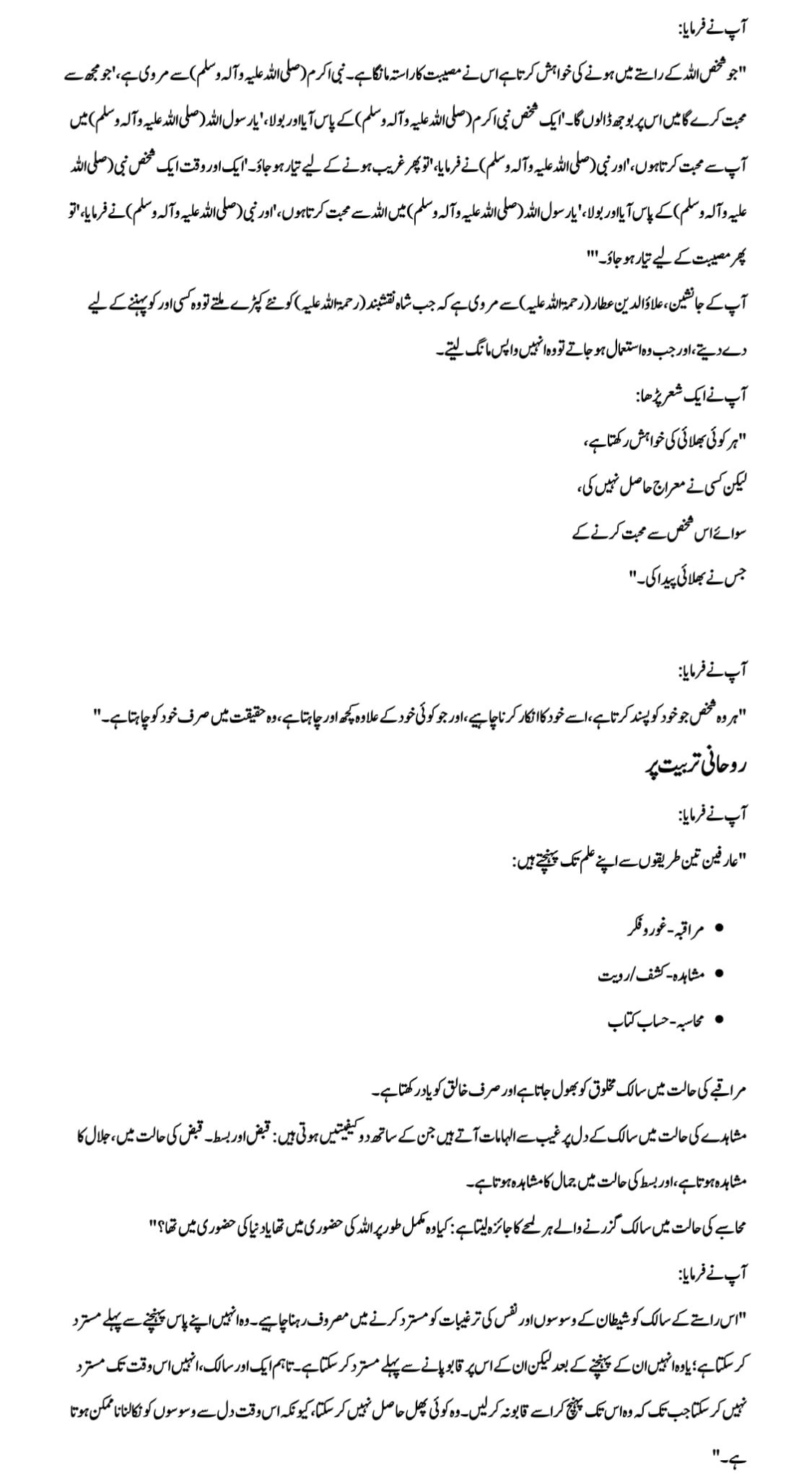
”Whoever desires to be on the path of Allah has asked for the path of affliction. It is narrated from the Holy Prophet (Sallallahu Alaihi Wa Aalihi Wasallam), ‘Whoever loves me, I shall place burdens upon him.’ A man came to the Holy Prophet (Sallallahu Alaihi Wa Aalihi Wasallam) and said, ‘O Messenger of Allah (Sallallahu Alaihi Wa Aalihi Wasallam), I love you,’ and the Prophet (Sallallahu Alaihi Wa Aalihi Wasallam) said, ‘Then prepare to be poor.’ Another time, a man came to the Prophet (Sallallahu Alaihi Wa Aalihi Wasallam) and said, ‘O Messenger of Allah (Sallallahu Alaihi Wa Aalihi Wasallam), I love Allah,’ and the Prophet (Sallallahu Alaihi Wa Aalihi Wasallam) said, ‘Then prepare for affliction.'”
It is narrated from his successor, Alauddin Attar (Rahmatullah Alaih), that when Shah Naqshband (Rahmatullah Alaih) received new clothes, he would give them to someone else to wear, and when they were worn out, he would ask for them back.
He recited a verse of poetry:
”Everyone desires goodness,
But no one attained the Ascension (Me’raj),
Except by loving the One
Who created goodness.”
He said:
”Everyone who pleases himself must deny himself, and whoever desires something other than himself, in reality, desires only himself.”
On Spiritual Training
He said:
”The gnostics (Arifeen) reach their knowledge through three methods:
Muraqabah – Meditation / Contemplation
Mushahadah – Witnessing / Vision / Kashf
Muhasabah – Self-examination / Accountability
In the state of Muraqabah, the seeker forgets the creation and remembers only the Creator.
In the state of Mushahadah, inspirations come to the seeker’s heart from the unseen, accompanied by two states: Qabz (contraction) and Bast (expansion). In the state of Qabz, Majesty (Jalal) is witnessed, and in the state of Bast, Beauty (Jamal) is witnessed.
In the state of Muhasabah, the seeker evaluates every passing moment: was he completely in the presence of Allah or in the presence of the world?”
He said:
”The seeker on this path must remain occupied in rejecting the whispers of Satan and the promptings of the lower self. He can reject them before they reach him; or he can reject them after they arrive but before they overcome him. However, another seeker cannot reject them until they reach him and control him. He cannot harvest any fruit, because at that time, extracting whispers from the heart is impossible.”
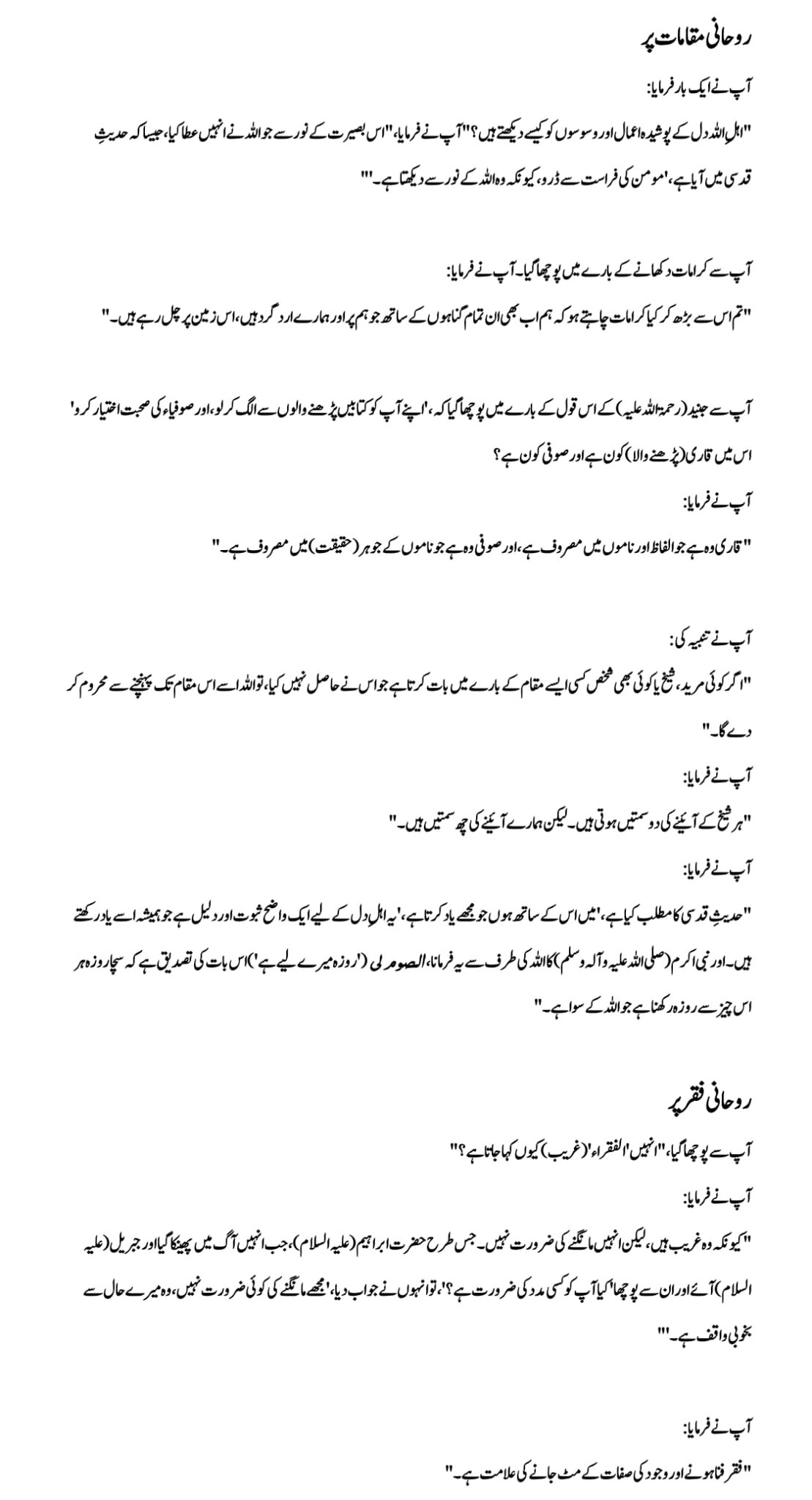
On Spiritual Stations
He was once asked, “How do the people of Allah see the hidden actions and whispers of the heart?” He replied, “Through the light of insight that Allah has bestowed upon them, as stated in the Hadith Qudsi, ‘Fear the foresight of the believer, for he sees with the light of Allah.'”
He was asked about showing miracles. He said:
”What greater miracle do you want than that we are still walking on this earth with all these sins that are upon us and around us.”
He was asked about the saying of Junayd (Rahmatullah Alaih), ‘Detach yourself from those who read books, and accompany the Sufis,’ who is the reader (Qari) and who is the Sufi? He said:
”The Qari is the one who is occupied with words and names, and the Sufi is the one who is occupied with the essence (Haqiqat) of the names.”
He warned:
”If any disciple, Sheikh, or any person speaks of a station that he has not attained, Allah will deprive him of reaching that station.”
He said:
”Every Sheikh’s mirror has two sides. But our mirror has six sides.”
He said:
”What is the meaning of the Hadith Qudsi, ‘I am with the one who remembers Me’? This is a clear proof and argument for the people of the heart who always remember Him. And the statement of the Holy Prophet (Sallallahu Alaihi Wa Aalihi Wasallam) from Allah, As-Sawmu Lee (‘Fasting is for Me’) is a confirmation that true fasting is to fast from everything other than Allah.”
On Spiritual Poverty (Faqa / Faqr)
He was asked, “Why are they called ‘Al-Fuqara’ (the poor)?” He said:
”Because they are poor, but they have no need to ask. Just like Hazrat Ibrahim (Alaihissalam), when he was thrown into the fire and Jibrail (Alaihissalam) came and asked him, ‘Do you need any help?’, he replied, ‘I have no need to ask, He is well aware of my state.'”
He said:
”Poverty (Faqr) is a sign of annihilation and the erasing of the attributes of existence.”
He once said:
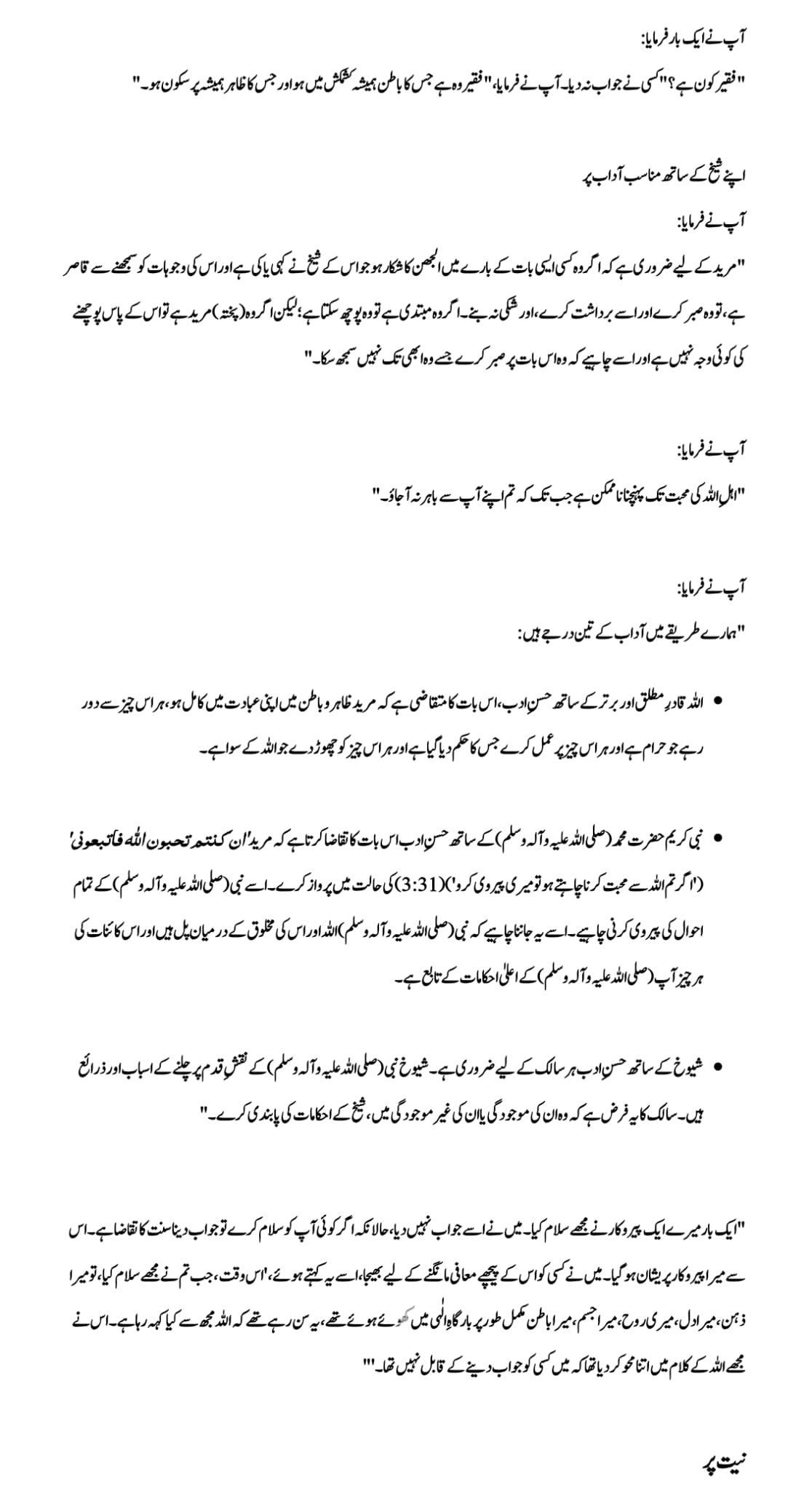
”Who is the Faqeer?” No one replied. He said, “The Faqeer is the one whose inward is always in struggle and whose outward is always peaceful.”
On Proper Etiquette with One’s Sheikh
He said:
”It is necessary for the disciple that if he is confused about something his Sheikh said or did and is unable to understand the reasons, he should be patient and bear it, and not become doubtful. If he is a beginner, he may ask; but if he is an (established) disciple, he has no reason to ask and should be patient with what he does not yet understand.”
He said:
”It is impossible to reach the love of the people of Allah until you come out of yourself.”
He said:
”In our path, there are three levels of etiquette (Adab):
Good etiquette with Allah, the Almighty and Exalted: This requires the disciple to be perfect in his worship outwardly and inwardly, staying away from everything that is forbidden, practicing everything that is commanded, and leaving everything that is other than Allah.
Good etiquette with the Holy Prophet Muhammad (Sallallahu Alaihi Wa Aalihi Wasallam): This requires the disciple to fly in the state of ‘In kuntum tuhibboonallah fattabi’ooni’ (‘If you love Allah, follow me’) (Quran 3:31). He must follow all the states of the Prophet (Sallallahu Alaihi Wa Aalihi Wasallam). He must know that the Prophet (Sallallahu Alaihi Wa Aalihi Wasallam) is the bridge between Allah and His creation, and everything in this universe is subject to his sublime commands.
Good etiquette with the Shuyukh: This is essential for every seeker. The Shuyukh are the means and instruments for walking in the footsteps of the Prophet (Sallallahu Alaihi Wa Aalihi Wasallam). It is the duty of the seeker to obey the commands of the Sheikh, whether in his presence or his absence.”
”Once, one of my followers greeted me with Salaam. I did not reply to him, even though replying to a greeting is a requirement of the Sunnah. This upset my follower. I sent someone after him to apologize, saying to him, ‘At that moment when you greeted me, my mind, my heart, my soul, my body, and my inward were completely lost in the Divine Presence, listening to what Allah was saying to me. It had absorbed me so much in the Word of Allah that I was unable to reply to anyone.'”
On Intention (Niyyah)
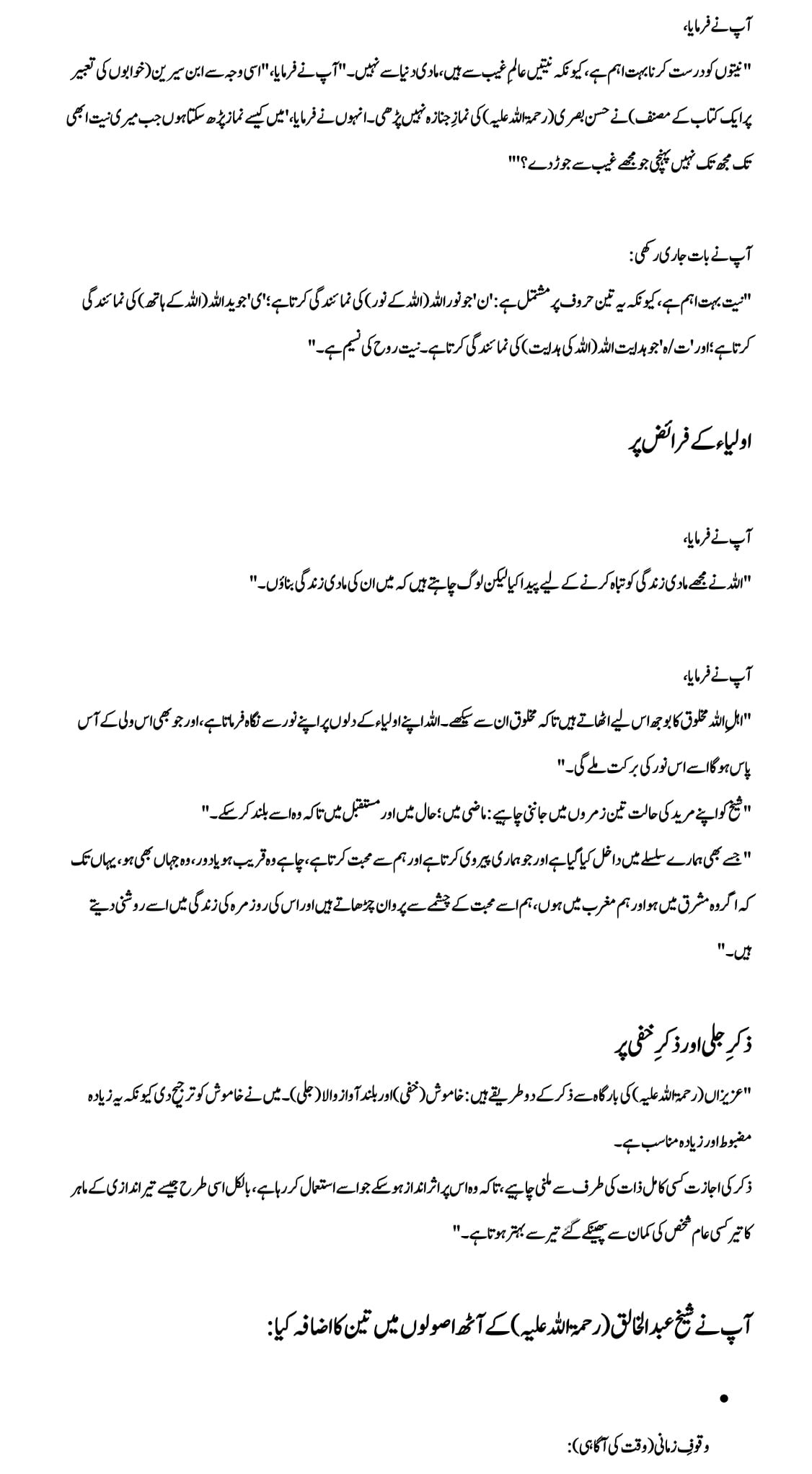
He said, “Correcting intentions is very important, because intentions belong to the realm of the unseen, not the material world.” He added, “For this reason, Ibn Sirin (the author of a book on dream interpretation) did not pray the funeral prayer of Hasan Al-Basri (Rahmatullah Alaih). He said, ‘How can I pray when my intention has not yet reached me to connect me to the unseen?'”
He continued:
”Intention is very important, because it consists of three letters: ‘Noon’ which represents Noorullah (the Light of Allah); ‘Ya’ which represents Yadullah (the Hand of Allah); and ‘Ta/Ha’ which represents Hidayatullah (the Guidance of Allah). Intention is the gentle breeze (Naseem) of the soul.”
On the Duties of the Awliya (Saints)
He said, “Allah created me to destroy material life, but people want me to build their material life.”
He said, “The people of Allah bear the burden of creation so that creation may learn from them. Allah gazes upon the hearts of His saints with His light, and whoever is around that saint will receive the blessing of that light.”
”The Sheikh must know his disciple’s state in three categories: in the past, in the present, and in the future, so that he may elevate him.”
”Whoever has been entered into our chain, follows us, and loves us, whether near or far, wherever he may be—even if he is in the East and we are in the West—we nurture him from the spring of love and give him light in his daily life.”
On Loud and Silent Remembrance
”From the presence of Azizan (Rahmatullah Alaih), there are two methods of remembrance: silent (Khafi) and loud (Jali). I preferred the silent because it is stronger and more appropriate.
The permission for Zikr must be received from a perfect personality, so that it may affect the one using it, just as the arrow of an expert archer is better than an arrow shot from the bow of an ordinary person.”
He added three principles to the eight principles of Sheikh Abdul Khaliq (Rahmatullah Alaih):
Waquf-e-Zamani (Awareness of Time): This means keeping an eye on one’s moderation and checking the tendency toward heedlessness (Ghaflat). The seeker must know how much time he has spent in moving toward spiritual maturity and must recognize where he has reached in his journey toward the Divine Presence. The seeker must progress with all his efforts. He must spend all his time in reaching his sole destination, Divine love, and the station of the Divine Presence. He must know that in all his efforts and actions, Allah is the witness to every minute detail. The seeker must keep an account of his actions and intentions every day and night and analyze his actions every hour, every second, and every moment. If they are good, he should thank Allah for it. If they are bad, he must repent and ask for Allah’s forgiveness. Yaqub al-Charkhi (Rahmatullah Alaih) stated that his Sheikh, Alauddin Attar (Rahmatullah Alaih), said, “In the state of sadness (Qabz), you should recite Istighfar (seeking forgiveness) abundantly, and in the state of joy (Bast), you should praise Allah abundantly.” And he said, “Keeping both these states, Qabz and Bast, in view is the meaning of Waquf-e-Zamani.” Shah Naqshband (Rahmatullah Alaih) explained this state, saying, “You must be aware of yourself. If you were following the Shariah, you must thank Allah; otherwise, you must seek forgiveness.”
Waquf-e-Adadi (Awareness of Numbers): This means that the seeker who is performing Zikr must observe the exact count of specific repetitions for the silent remembrance of the heart. Keeping count of the Zikr is not for the sake of counting itself, but to protect the heart from bad thoughts and to force it to focus more attention on this effort so that the repetition prescribed by the Sheikh can be achieved as soon as possible. The pillar of Zikr through counting is to bring the heart into the presence of the One Who is remembered in this Zikr, and to continue counting one by one so that one’s attention is drawn to the realization that everyone is in need of that Unique Being Whose signs are manifest in every creature. Shah Naqshband (Rahmatullah Alaih) said, “Adherence to numbers in Zikr is the first step in attaining Ilm-e-Ladunni (heavenly knowledge).” This means that counting leads a person to recognize that only ‘One’ (Allah) is necessary for life. All mathematical equations require the number one. All creation is in need of that Unique Being.
Waquf-e-Qalbi (Awareness of the Heart): This means that the seeker’s heart should be directed toward the Divine Presence, where he sees none but his Beloved. This means experiencing His manifestation in every state. Ubaidullah Al-Ahrar (Rahmatullah Alaih) said, “The state of awareness of the heart is to be present in the Divine Presence in such a way that you cannot look toward anyone else.” In such a state, a person concentrates the place of Zikr within the heart because it is the center of power. All good and bad thoughts and inspirations are felt and manifest one after another, circling, moving between light and darkness, constantly circulating within the heart. To control and reduce this agitation of the heart, Zikr is necessary.
The Meaning of the Ummah of Muhammad (Sallallahu Alaihi Wa Aalihi Wasallam)
He said:
”When the Prophet (Sallallahu Alaihi Wa Aalihi Wasallam) said, ‘The part of my Ummah destined for Hell is like the part of Hazrat Ibrahim (Alaihissalam) destined for the fire of Namrud,’ he was giving glad tidings of the salvation of his Ummah, just as Allah wrote salvation for Ibrahim (Alaihissalam): ‘Ya naaru koonee bardan wa salaman ala Ibraheem’ (‘O fire, be coolness and safety upon Ibrahim’) (Quran 21:69). This is because the Prophet (Sallallahu Alaihi Wa Aalihi Wasallam) said, ‘My Ummah will never agree upon misguidance溫, confirming that the Ummah will never accept wrongdoing, and thus Allah will save the Ummah of Hazrat Muhammad (Sallallahu Alaihi Wa Aalihi Wasallam) from the fire.”
Sheikh Ahmad Faruqi (Rahmatullah Alaih) stated that Shah Naqshband (Rahmatullah Alaih) says:
”The Ummah of Hazrat Muhammad (Sallallahu Alaihi Wa Aalihi Wasallam) includes everyone who comes after the Prophet (Sallallahu Alaihi Wa Aalihi Wasallam). It consists of three categories:
Ummah al-Da’wah (The Ummah of Invitation): Absolutely everyone who came after the Prophet (Sallallahu Alaihi Wa Aalihi Wasallam) and merely heard his message. It is clear from many verses of the Quran that the Prophet (Sallallahu Alaihi Wa Aalihi Wasallam) came for all people without exception; furthermore, your Ummah is a witness over all other nations, and the Prophet (Sallallahu Alaihi Wa Aalihi Wasallam) is a witness over everyone, including other nations and their respective witnesses.
Ummah al-Ijabah (The Ummah of Acceptance): Those who accepted the message.
Ummah al-Mutaba’ah (The Ummah of Following): Those who accepted the message and walked in the footsteps of the Prophet (Sallallahu Alaihi Wa Aalihi Wasallam).
All these classes of the Prophet’s (Sallallahu Alaihi Wa Aalihi Wasallam) Ummah are forgiven. If they are not forgiven by their actions, they will be forgiven by the intercession (Shafa’at) of the Prophet (Sallallahu Alaihi Wa Aalihi Wasallam), according to his saying, ‘My intercession is for the major sinners of my Ummah.'”
On Access to the Divine Presence
He said:
”The meaning behind the Hadith of the Holy Prophet (Sallallahu Alaihi Wa Aalihi Wasallam), ‘As-Salatu Me’raj-ul-Mu’min’ (‘Prayer is the Ascension of the believer’), clearly points to the ranks of true prayer, in which the worshiper ascends to the Divine Presence. In it, fear, reverence, obedience, and humility manifest in such a way that his heart reaches a state of meditation through his prayer. This will lead him to witness the Divine secrets. This was the description of the prayer of the Holy Prophet (Sallallahu Alaihi Wa Aalihi Wasallam). It is stated in the biography of the Prophet (Sallallahu Alaihi Wa Aalihi Wasallam) that when the Prophet (Sallallahu Alaihi Wa Aalihi Wasallam) reached this station, people outside the city could hear a sound from his chest like the buzzing of bees.”
A scholar of Bukhara asked him, “How can a worshiper reach the Divine Presence in his prayer?” He replied, “By eating the lawful (Halal) earnings from the sweat of his brow, and by remembering Allah, the Almighty and Exalted, inside his prayer and outside his prayer, in every ablution, and at every moment of his life.”
His servant, Sheikh Salah (Rahmatullah Alaih), narrated: “Shah Naqshband (Rahmatullah Alaih) once said to his followers, ‘Your heart’s attachment to anything other than Allah is the greatest veil for the seeker,’ after which he recited this verse of poetry:
’Attachment to anything other than God
Is the strongest veil,
And ridding oneself of it,
Is the opening of the door of union.’
Immediately after reading this verse, the thought occurred to my heart that his reference was to the relationship between faith (Iman) and Islam. He looked at me, laughed, and said, ‘Have you not heard what Mansur Al-Hallaj said? “I denied the religion of God, and denial is obligatory upon me, though it is heinous to Muslims.” O Sheikh Salah, what came to your heart—that attachment is to faith and Islam—is not the main point. What is important is “true faith,” and for the people of truth, true faith is that the heart denies anything other than God. This is what compelled Hallaj to say, “I denied your religion, and denial is obligatory upon me, though it is heinous to Muslims.” His heart wanted nothing but Allah.'”
”Hallaj, certainly, was not denying his faith in Islam, but was only emphasizing his heart’s exclusive attachment to Allah. If Hallaj was accepting nothing other than Allah, how can anyone say that he was actually denying the religion of God? The testimony of the reality of his witnessing absorbed the common testimony of the ordinary Muslim and made it like children’s play.”
Sheikh Salah (Rahmatullah Alaih) continued, saying that Shah Naqshband (Rahmatullah Alaih) said: “The people of Allah do not praise what they are doing; they act solely because of the love of God.”
Shah Naqshband (Rahmatullah Alaih) said:
”Rabia al-Basri said, ‘O Allah! I have not worshiped You seeking the reward of Your Paradise or out of fear of Your punishment, but I have worshiped You solely for Your love.’ If your worship is to save yourself or to gain a reward for yourself, it is hidden shirk (associating partners with Allah), because you have associated something among reward or punishment with Allah. This is what Hallaj (Rahmatullah Alaih) meant.”
Sheikh Arslan al-Dimashqi (Rahmatullah Alaih) said, as stated by Shah Naqshband (Rahmatullah Alaih):
”O God, Your religion is nothing but hidden shirk, and it is obligatory upon every true servant to deny it. The people of religion do not worship You, but are only worshiping to attain Paradise or to escape Hell. They worship both of them like idols, and this is the worst idolatry. You have said, ‘Whoever denies false deities and believes in God has grasped the most trustworthy handhold.’ (Quran 2:256) Denying these idols and believing in You is obligatory upon the people of truth.”
One of the greatest Sufi Shuyukh, Sheikh Abu al-Hasan al-Shadhili (Rahmatullah Alaih), was asked by his Sheikh (Rahmatullah Alaih), “O my son, with what will you meet your Lord?” He said, “I am coming to Him with my poverty (Faqr / neediness).” His Sheikh (Rahmatullah Alaih) replied:
”O my son, never repeat this again. This is the greatest idol, because you are still coming to Him with something. Free yourself from everything and then come to Him. The people of outward knowledge and Shariah hold tightly to their actions, and on this basis, they establish the concept of reward and punishment. If they are good, they find good, and if they are bad, they find bad; what benefits the servant are his actions and what harms him are his actions. To the people of the spiritual path (Tariqah), this is hidden shirk, because a person is associating something with God. Although doing these (good deeds) is an obligation, yet the heart should not be attached to these actions. They should be done solely for His sake and for His love, without expecting anything in return.”
On the Naqshbandi Chain
Shah Naqshband (Rahmatullah Alaih) said:
”Our path is very rare and very precious. It is the Urwat-ul-Wuthqa (“the trustworthy handhold”), the path of remaining firm and steadfast upon the footsteps of the Prophet (Sallallahu Alaihi Wa Aalihi Wasallam) and his Companions (Radi Allahu Anhum). They brought me to this path through the gate of favors, because at its beginning and at its end, I saw nothing but the favors of God. On this path, the great gates of heavenly knowledge will be opened to the seeker who walks in the footsteps of the Prophet (Sallallahu Alaihi Wa Aalihi Wasallam).”
Following the Sunnah of the Prophet (Sallallahu Alaihi Wa Aalihi Wasallam) is the most important means by which the door will be opened for you. He said, “Whoever is not coming to our path, his religion is in danger.” He was asked, “How does someone come to your path?” He replied, “By following the Sunnah of the Prophet (Sallallahu Alaihi Wa Aalihi Wasallam).”
He said:
”We have borne humiliation on this path, and in return, Allah has blessed us with His honor.”
Some people said about him that he was sometimes proud. He said, “We take pride because of Him, because He is our Lord, Who is granting us His help!”
He said:
”Reaching the secrets of Unity (Wahdat) is sometimes possible, but reaching the secrets of spiritual knowledge (Ma’rifat) is extremely difficult.”
He said:
”Spiritual knowledge is like water; it takes the color and shape of the vessel. The knowledge of Allah is so great that no matter how much we take, it is like a drop from a vast ocean. It is like an expansive garden; no matter how much we have cut from it, it is as if we have cut only a single flower.”
His Attitude Toward Food
Shah Naqshband (Rahmatullah Alaih), may Allah sanctify his soul, was at the highest levels of denying the desires of this world. He adopted the path of piety, especially in the act of eating. He took every kind of precautionary measure regarding his food. He ate only the barley that he grew himself. He harvested it himself, ground it, made the flour, kneaded it, and baked it himself. All the scholars and seekers of his time would head to his house to eat from his table and share in the blessings of his food.
He reached such perfection of simplicity that in winter, he would spread only old and torn carpets on the floor of his house, which provided no protection from the biting cold. In summer, he would spread very thin woven mats on the ground. He loved the poor and the needy. He urged his followers to earn money through lawful means, i.e., from the sweat of their brow. He urged them to spend that money on the poor. He cooked food for the poor and invited them to his table. He served them with his holy hands and urged them to always remain in the presence of Allah, the Almighty and Exalted. If any of them placed a morsel in his mouth in heedlessness, he would inform them through his state of Kashf what they had done and urge them to remember Allah while eating.
He taught that:
”One of the most important gates to the Divine Presence is eating with awareness (presence of the heart / Huzoor-e-Qalb). Food gives strength to the body, and eating with consciousness gives purity to the body.”
Once he was invited to a city named Ghazyut, where one of his followers had prepared dinner for him. When they sat down for dinner, he did not eat. His host was surprised. Shah Naqshband (Rahmatullah Alaih) said, “O my son, I wonder how you prepared this food. From the time you kneaded the flour and baked it, until you served it, you were in a state of anger. The food has mixed with that anger. If we eat this food, Satan will find a way to enter through it and spread his evil throughout our entire body.”
Once he was invited to the city of Herat by its king, King Hussain. King Hussain was very pleased with the arrival of Shah Naqshband (Rahmatullah Alaih) and arranged a grand feast for him. He invited all his ministers, the Shuyukh of his kingdom, and all his dignitaries. He said, “Eat from this food. It is pure food, which I have made from the pure earnings I inherited from my father.” Everyone ate except Shah Naqshband (Rahmatullah Alaih), upon which the Sheikh-ul-Islam of that time, Qutbuddin (Rahmatullah Alaih), asked, “O our Sheikh, why are you not eating?” Shah Naqshband (Rahmatullah Alaih) said, “I have a judge to whom I go for advice. I asked him, and that judge told me, ‘O my son, there are two possibilities regarding this food. If this food is not lawful and you do not eat, when you are questioned, you can say that I came to the king’s table but I did not eat. Then you are safe because you did not eat. But if you eat and you are questioned, then what will you say? Then you are not safe.'” At that moment, Qutbuddin (Rahmatullah Alaih) was so overwhelmed by these words that he began to tremble. He had to ask permission from the king to stop eating. Then the king became very confused and asked, “What shall we do with all this food?” Shah Naqshband (Rahmatullah Alaih) said, “If there is any doubt about the purity of the food, it is better to send it to the poor. Their need will make it lawful for them. If, as you say, it is lawful, then instead of feasting people who do not need it, there is more blessing in giving it as charity to those who are in need.”
He spent most of his days fasting. If a guest came to him and he had something to offer him, he would sit with him, break his fast, and eat. He told his followers that the Companions (Radi Allahu Anhum) of the Prophet (Sallallahu Alaihi Wa Aalihi Wasallam) used to do the same. Sheikh Abu al-Hasan al-Kharqani (Rahmatullah Alaih) wrote in his book, “Maintain harmony with friends, but not in sin. This means that if you are fasting and someone comes to you as a friend, you should sit with him and eat with him so that proper company can be maintained with him. One of the principles of fasting or any worship is that a person should hide what he is doing. If someone manifests it, for example by telling a guest, ‘I am fasting’, then pride may enter and ruin the fast. This is the reason behind this principle.”
One day, he was given cooked fish as a gift. Many poor people were present with him, among them was a very pious boy who was fasting. Shah Naqshband (Rahmatullah Alaih) gave that fish to the poor and said to them, “Sit and eat,” and he said to the boy who was fasting, “Sit and eat.” The boy refused. He told him again, “Break your fast and eat,” but he refused. He asked him, “If I give you one of my days of Ramadan, will you sit and eat?” He refused again. He said to him, “What if I give you my entire Ramadan?” Still he refused. He said, “Bayazid Bastami (Rahmatullah Alaih) was also once afflicted with a person just like you.” After that, that boy was seen running after worldly life; he never fasted again and never worshiped.
The incident to which Shah Naqshband (Rahmatullah Alaih) was referring occurred one day when Sheikh Abu Turab al-Nakhshabi (Rahmatullah Alaih) visited Bayazid Bastami (Rahmatullah Alaih). His servant offered them food. Abu Turab (Rahmatullah Alaih) said to the servant, “Come and sit with me and eat.” The servant said, “No. I am fasting.” He said, “Eat, and Allah will grant you the reward of a year’s fasting.” He refused. He said, “Come and eat, I will pray to Allah to grant you the reward of two years’ fasting.” Then Hazrat Bayazid (Rahmatullah Alaih) said, “Leave him. He has fallen from the care of Allah.” Later, his life suffered a decline and he became a thief.
His Miracles and Generosity
The state of Shah Naqshband (Rahmatullah Alaih) is beyond description, and the vastness of his knowledge cannot be expressed. One of his greatest miracles was his very existence. He often hid his actions so that miracles would not be displayed. However, many of his miracles are preserved in history.
Shah Naqshband (Rahmatullah Alaih) said:
”One day, I went out toward the desert with Muhammad Zahid (Rahmatullah Alaih). He was a true disciple, and we had a Plow with which we were digging. As we were working with the Plow, we were discussing such deep stations of knowledge that we threw the Plow aside and entered into the depths of spiritual knowledge. We were going deeper until the conversation brought us to the nature of worship. He asked me, ‘O my Sheikh, to what extent does worship reach?’ I said, ‘Worship reaches such perfection that the worshiper can say to someone “Die”, and that person will die.’ Without thinking, I pointed toward Muhammad Zahid (Rahmatullah Alaih). He immediately fell down dead. He remained in a state of death from sunrise until noon. It was very hot. I was very worried because the intense heat was affecting his body. I dragged him into the shade of a tree and sat there reflecting on the matter. While I was reflecting, an inspiration came to my heart from the Divine Presence, telling me to say to him, ‘O Muhammad, come to life!’ I said it to him three times. In response, his soul slowly began to enter his body, and life slowly began to return to him. He gradually returned to his original state. I went to my Sheikh and told him what had happened. He said, ‘O my son, Allah has given you a secret that He did not give to anyone else.'”
Sheikh Alauddin Attar (Rahmatullah Alaih) narrated:
”Once, the king of Mawar-un-Nahr, Sultan Abdullah Kazgan, came to Bukhara. He decided to go hunting around Bukhara, and many people went with him. Shah Bahauddin Naqshband (Rahmatullah Alaih) was in a nearby village. When the people went out for hunting, Shah Naqshband (Rahmatullah Alaih) went to the top of a hill and sat there. While sitting there, the thought occurred to his heart that Allah has granted great honor to the saints. Because of this honor, all the kings of this world should bow before them. This thought had barely passed through his heart when a crowned horseman, looking like a king, came into his presence and dismounted his horse. With great humility, he greeted Shah Naqshband (Rahmatullah Alaih) and stood before him in an extremely respectful manner. He bowed before the Sheikh (Rahmatullah Alaih), but the Sheikh did not look at him. He kept him standing for an hour. Finally, Shah Naqshband (Rahmatullah Alaih) looked up and said, ‘What are you doing here?’ He said, ‘I am the king, Sultan Kazgan. I went out for hunting and smelled a very beautiful fragrance. I followed it here and found you sitting in the midst of a powerful light.’ His thought—’all the kings of this world should bow before the saints’—had immediately become reality. In this way, Allah honors the thoughts of His saints.”
One of his followers who served him in the city of Merv narrated:
”One day, I desired to go visit my family in Bukhara, as I had received news that my brother Shamsuddin had passed away. I needed to seek permission from my Sheikh to leave. I spoke to the prince of Herat, Amir Hussain, to ask for permission on my behalf from Shah Naqshband (Rahmatullah Alaih). Upon returning from the Friday prayer, Amir Hussain informed him about my brother’s death and that I wished for permission to go to my family. He said, ‘No, that is impossible. How can you say he is dead when I can see him alive? Moreover, I can even smell his fragrance. I am about to bring him here right now.’ He had barely finished his words when my brother appeared. He came to the Sheikh, kissed his hand, and greeted Amir Hussain. I embraced my brother, and we experienced great joy.”
”Sheikh Shah Naqshband (Rahmatullah Alaih) was once sitting in a large gathering in Bukhara, speaking about ‘the vision of the state of witnessing’ (Kashf of the state of Mushahadah). He said, ‘My best friend, Mawla Arif (Rahmatullah Alaih), who is in Khwarazm (400 miles away from Bukhara), left Khwarazm for the government building and has reached the carriage stand. When he reached that stand, he stopped there for a moment and is now returning to his house in Khwarazm. He is not proceeding toward the inn. In this way, a saint can see from his station of spiritual knowledge.’ Everyone was astonished by this story, but we all knew that he was a great saint, so we noted the time and day. One day, Mawla Arif (Rahmatullah Alaih) came to Bukhara from Khwarazm, and we informed him about this incident. He was very surprised and said, ‘In reality, exactly that had happened.'”
Sheikh Alauddin Attar (Rahmatullah Alaih) narrated:
”Some scholars of Bukhara traveled to Iraq with some followers of Shah Naqshband (Rahmatullah Alaih) when they reached the city of Samnan. They heard that there was a blessed person named Sayyid Mahmoud (Rahmatullah Alaih) there, who was a disciple of the Sheikh. They went to his house to meet him and asked him, ‘How did you establish contact with the Sheikh?’ He said, ‘One night, I saw the Prophet (Sallallahu Alaihi Wa Aalihi Wasallam) in a dream, seated in a very fine place, and a person of majesty was sitting near him. With complete respect and humility, I submitted to the Prophet (Sallallahu Alaihi Wa Aalihi Wasallam), “O Messenger of Allah (Sallallahu Alaihi Wa Aalihi Wasallam), I did not have the honor of becoming your Companion during your lifetime. What can I do in my life that would be closest to this honor?” He (Sallallahu Alaihi Wa Aalihi Wasallam) said to me, “O my son, if you wish to attain honor by becoming our friend, sitting with us, and being blessed, then you must follow my son, Shah Bahauddin Naqshband (Rahmatullah Alaih).” I asked again, “Who is Shah Bahauddin Naqshband (Rahmatullah Alaih)?” He said to me, “Do you see this person sitting next to me? This is him. Remain in his company.” I had never seen him before. When I awoke, I wrote his name and his appearance in a book that is in my library. A considerable amount of time passed after this dream, until one day, while I was standing at a shop, I saw a man of radiant and majestic appearance coming into the shop and sitting on a chair. When I saw him, I remembered the dream and what had happened in it. I immediately asked him if he would honor me by coming to my house and staying with me. He accepted and began walking ahead of me while I walked behind. I was ashamed to walk ahead of him, even to show the way to my house. He did not look at me even once, but took the way straight to my house. I was just about to say, “This is my house,” when he said, “This is your house.” He went inside and went straight to my private room. He said, “This is your room.” He went to the cupboard and pulled out one book from among hundreds of books. He gave me the book and asked me, “What have you written in this?” It was exactly what I had seen in the dream. Immediately, a state of unconsciousness overcame me, and I fainted from the light that descended into my heart. When I awoke, I asked him if he would accept me. He was Shah Bahauddin Naqshband (Rahmatullah Alaih).'”
Muhammad Zahid (Rahmatullah Alaih) narrated:
”At the beginning of the journey on the path, I was sitting with him one day in spring. A desire for watermelon arose in my heart. He looked at me and said, ‘Muhammad Zahid, go to this river near us and bring what you see, and we shall eat it.’ I immediately went to the river. The water was very cold. I put my hand into it and found a watermelon under the water, very fresh, as if just cut from the vine. I was very happy, took the watermelon, and said, ‘O my Sheikh, accept me.'”
It is narrated concerning Sheikh Muhammad Zahid (Rahmatullah Alaih) that one of his followers was going to visit him. Before the meeting, he sought advice from one of the senior disciples, Sheikh Shadi (Rahmatullah Alaih). “He said to me, ‘O my brother, when you visit the Sheikh or when you are sitting in the presence of the Sheikh, be careful not to place your legs in such a way that your feet face toward him.’ As I left Ghazyut on the way to Qasr-e-Arifan, I found a tree and lay down under it stretching out my legs. Unfortunately, an animal came and bit my leg. Later, because of the pain, I fell asleep again, and while I was sleeping, an animal bit me again. Suddenly I realized that I had made a huge mistake; I had stretched out my feet in the direction of the Sheikh. I immediately repented, and the animal that bit me left.”
Once he was forced to show a miracle in defense of one of his successors, Sheikh Muhammad Parsa (Rahmatullah Alaih), in Bukhara. This happened when Sheikh Muhammad Shamsuddin Jazari (Rahmatullah Alaih) came to Samarkand during the reign of King Mirza Ulugh Beg to determine the correctness of the chains of transmission (Asnad) of the Ahadith of the Prophet. Some envious and corrupt scholars had complained that Sheikh Muhammad Parsa (Rahmatullah Alaih) was narrating Ahadith whose chains of transmission were unknown. They told Shamsuddin (Rahmatullah Alaih), “If you attempt to solve this issue, Allah will grant you a great reward.” Sheikh Muhammad Shamsuddin (Rahmatullah Alaih) asked the Sultan to command Sheikh Muhammad Parsa (Rahmatullah Alaih) to appear. The Sheikh-ul-Islam of Bukhara, Husamuddin Nahwi (Rahmatullah Alaih), was present there along with many scholars and Imams of that region.
Shah Naqshband (Rahmatullah Alaih) came to the meeting with Muhammad Parsa (Rahmatullah Alaih). Then Sheikh Husamuddin (Rahmatullah Alaih) asked Muhammad Parsa (Rahmatullah Alaih) about a Hadith. Muhammad Parsa (Rahmatullah Alaih) narrated the Hadith along with its chain of transmission. Sheikh Muhammad Jazari (Rahmatullah Alaih) said, “There is no error in the Hadith, but the chain of transmission is wrong.” Hearing this, the envious scholars were pleased. They asked Muhammad Parsa (Rahmatullah Alaih) to provide another chain of transmission for the Hadith. He did, and again it was said that it was not correct. They asked for another chain, and he gave it, and still they found fault in it.
Shah Naqshband (Rahmatullah Alaih) intervened, because he knew that whatever chain of transmission they gave, they would call it wrong. He inspired Muhammad Parsa (Rahmatullah Alaih) to ask a question to Sheikh Husamuddin (Rahmatullah Alaih) and say to him, “You are the Sheikh-ul-Islam and the Mufti. From what you have learned from outward knowledge, Shariah, and the science of Hadith, what do you say about such-and-forth narrator?” Sheikh Husamuddin (Rahmatullah Alaih) said, “We accept that person, and we build a large part of our science of Hadith upon his narrations, and his book is accepted among us, and his lineage is such that all scholars acknowledge it, and there is no debate on this matter.” Muhammad Parsa (Rahmatullah Alaih) said, “The book of that person which you acknowledge is in your house in your library among such-and-such books. It has 500 pages, its color is such-and-such, and the cover looks like such-and-such, and the Hadith which you rejected was written by that person on such-and-such page.”
Sheikh Husamuddin (Rahmatullah Alaih) became confused and doubts arose in his heart, because he did not remember seeing any such book in his library. Everyone was surprised that the Sheikh would know about the book while the owner did not know about it. There was no choice but to send someone to check. The Hadith was found exactly as Muhammad Parsa (Rahmatullah Alaih) had mentioned. When the king heard about this story, the scholars who brought the allegations were humiliated, and the ranks of Shah Naqshband (Rahmatullah Alaih) and Muhammad Parsa (Rahmatullah Alaih) were elevated.
Final Days and Passing
One of the servants of the Sheikh, Sheikh Ali Damman (Rahmatullah Alaih), narrated: “The Sheikh commanded me to dig his grave. When I completed it, it came to my heart, ‘Who will be his successor?’ He raised his head from the pillow and said to me, ‘O my son, do not forget what I said to you when we were on the way to Hejaz. Whoever wishes to follow me must follow Sheikh Muhammad Parsa (Rahmatullah Alaih) and Sheikh Alauddin Attar (Rahmatullah Alaih).'”
In his final days, he remained in his room. People traveled to visit him, and he advised them. When he entered his final illness, he shut himself in his chamber. His followers began coming to visit him in crowds, and he gave each of them the advice they needed. On one occasion, he commanded them to recite Surah Ya-Sin. Then, when they completed the Surah, he raised his hands to the Divine Presence. Then he raised his right finger to recite the Testimony of Faith (Kalimah Shahadat). As soon as he completed it, his soul returned to Allah.
His passing occurred on the Monday night of 3rd Rabi-ul-Awwal, 791 AH (1388 CE). He was buried in his garden according to his will. The subsequent kings of Bukhara looked after his madrasah and mosque, expanded them, and increased their religious endowments.
The Qutb of his time, Abdul Wahhab Sha’rani (Rahmatullah Alaih), said: “When the Sheikh was buried in his grave, a window to Paradise was opened for him, making his grave a garden of Paradise. Two beautiful spiritual entities entered his presence, greeted him, and said to him, ‘Since Allah created us, we have been waiting for this moment to serve you.’ He said to those two spiritual entities, ‘I look toward nothing except Him (Allah). I do not need you; rather, I need my Lord.'”
Shah Naqshband (Rahmatullah Alaih) left many successors, among whom the most distinguished were Sheikh Muhammad bin Muhammad Alauddin Khwarazmi Al-Bukhari Al-Attar (Rahmatullah Alaih) and Sheikh Muhammad bin Muhammad bin Mahmoud Al-Hafizi (Rahmatullah Alaih), known as Muhammad Parsa (Rahmatullah Alaih), the author of ‘Risalah Qudsiyyah’. Shah Naqshband (Rahmatullah Alaih) had transmitted the secret of the Golden Chain (Silsilah-e-Zahab) to the former (i.e., Sheikh Alauddin Attar) (Rahmatullah Alaih).